At the POWERYOUTH Programme, most of the theme was about how hard is "going nonprofit" and "getting involved" at the same time. We believe there is a way for every goal to be realized.
In our proposal, we modeled—partly using the decision tool—an energy community located in Wörgersdorf, Austria. The energy community includes several farms and residential buildings that are connected to the same service area of a 0.4 kV substation. Initially, we consider only the electricity side of the energy community, but the cattle on the farms could allow us to extend the model to include biogas production or biogas-powered district heating. With diverse electricity consumption profiles, members of an energy community can collectively derive greater economic benefits from a PV&BESS system than they could individually.
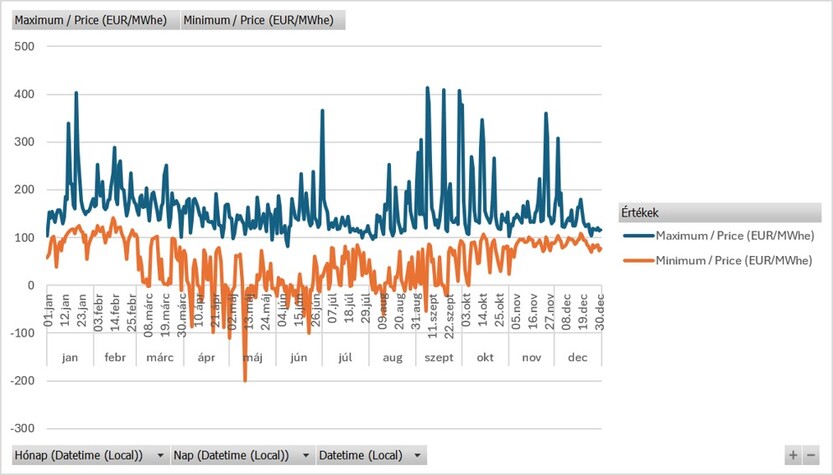
In the model, we selected the roof surfaces of 3 agricultural buildings, one for each cardinal direction, excluding the north. For cost-efficient reasons, the bigger PV projects are better, and this way, they can produce electricity from dawn till dusk. The integrated PV capacity is 60 kWp, with 3 inverters rated nearly 20 kW each, and they can produce approximately 72 MWh of electricity on a yearly basis. For the optimal BESS selection, we observed the DAM market of Austria and the typical combined profiles of the members of the energy community for each hour of the year. The mixture of residential and agricultural consumption profiles makes a nearly flat demand for electricity from 6 am to 10 pm in the energy community. With the selected 50 kW/150kWh BESS, the energy community can increase the local usage of the PV and also can transfer cheap energy to the expensive hours and decrease the annual average price of the purchased electricity.
The payback period of a project like this in a C&I environment is around 3-5 years, depending on the consumption profile. However, in energy communities and other nonprofit organisations — unlike in industrial projects — profit is not the primary objective; it is merely a means to ensure sustainable operation. As we heard from the participants of the POWERYOUTH EU Capacity Building Programme in Vicenza, the sustainable operation of the energy communities sometimes depends on the volunteer work of young people, and this threatens the cheap and renewable energy sources of the communities. For an engineer, this means that optimization was based solely on energy cost, rather than on long-term sustainability or feasibility.
In our model, we optimize not only for energy cost but for long-term sustainability and for feasibility. The BESS&PV hybrid system is financed over a 15-year period at a WACC of 3% (in profit-oriented projects, it's 5% or over), and the electricity price from the PV is 10 euro cents/kWh. The BESS&PV hybrid system makes more than 500 €/year more in revenue than its financing and operating cost. This result can be used to hire an external professional for a few hours per month, which can save a lot of difficult volunteer work and improve operations, so that volunteer work can remain where it is still useful. In the first year, the operating cost is nearly zero, so that year's result is way higher, and it makes a big financial reserve for the energy community, but there is also a possibility to ask for a connection fee from the members.
With an electricity price of 10 euro cents/kWh and an optimally sized BESS, the energy community can achieve financial stability, allowing young people and volunteers to focus on long-term engagement and building a strong community. It is very important to consider all necessary aspects, rather than focusing exclusively on reducing energy costs through the use of renewable energy. If the electricity price is set too low, the energy community may be financially unsustainable or even unfeasible. There is a strong need for support from groups such as OurPower and for the other tools presented to us through the POWERYOUTH Programme to help energy communities access know-how and engineering services. Energy as a service and power purchase agreements can both be good options for energy communities that want BESS&PV hybrid systems without significant upfront capital expenditure.

Most voted