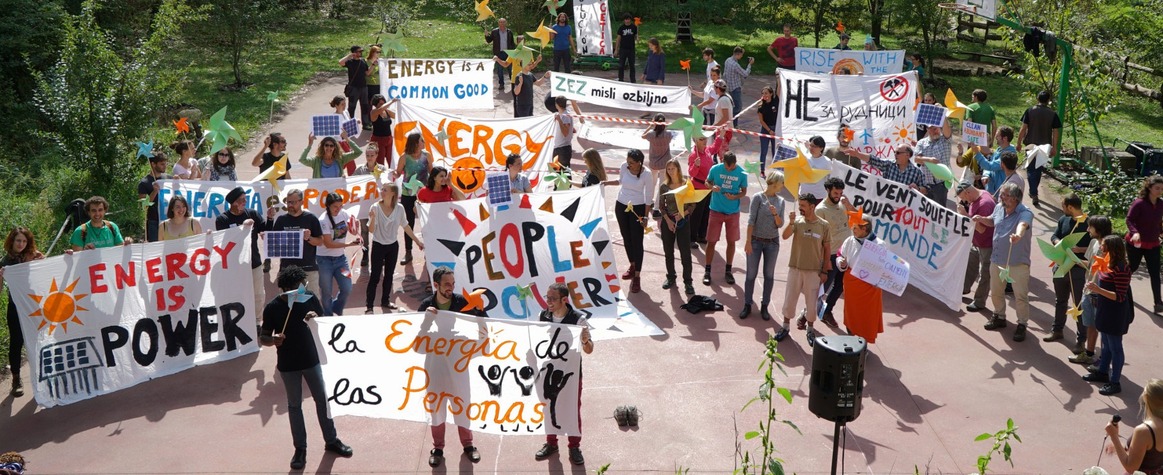
People power: a multilingual crowd with banners saying energy is a common good
Proposal code:
CONSUL-2026-11-64
Climate influencers, local politicians and university chapters launch neighbourhood energy communities, backed by a local advisory body, grants and a fair grid-provider partnership.
Energy Community Action (ECA) is a concept for helping neighbours, students and local institutions set up energy communities, where residents jointly produce, share and use renewable energy. Many people would like to take part but do not know how to start, who to talk to, or how a community fits into the existing grid and the rules around it. ECA closes this gap by combining public awareness, a clear framework for government support, and fair cooperation with energy providers.
Who starts it and who takes part
The initial promoters come from three groups. Climate influencers can reach young people and make the topic visible. Local assembly members and parliamentarians can open doors to municipal and national support and put energy communities on the political agenda. ECA chapters created at universities give students and researchers a base to organise events, test ideas and recruit members.
Energy providers and tenant assemblies are expected to take part from the start. Providers are partners for grid connection and supply. Tenant assemblies bring in the voice of renters, who often cannot install panels themselves but should still benefit from cheaper local energy.
Initial objectives
First, create a policy framework between communities and the government that makes support and grants easy to access. Second, agree fair protocols with grid and electricity providers, so that energy communities can be integrated into the grid and receive fair compensation for the energy they feed in.
Planned activities
The core activity is a local advisory body that oversees the community. It would bring together members, tenant representatives, local government and energy providers. It checks how funds are used, follows up on agreements with providers and gives members a place to raise concerns, so that decisions stay transparent and accountable. Around it, the university chapters organise information events and help neighbours form the first groups.
Financing
The first phases would be financed through a mix of sources: government grants covering a smaller share of the costs (under 25%), loans for the remaining set-up costs, and a partnership with the grid provider built around curtailment for supply. In such an arrangement, the community agrees to reduce its output when the grid is congested and in return secures agreed supply terms. There are no related activities or projects underway yet, so ECA starts from a clean slate.
Expected challenges
We expect four main obstacles: keeping collective commitment over time, managing expectations about how fast savings appear, high initial entry fees, and technical complexity. We plan to respond with clear communication about what members can realistically expect, a phased start that spreads the costs, grants and loans to lower the entry barrier, and technical guidance shared between communities.
Scope and legal form
ECA starts at neighbourhood level, with neighbourhood communities clustered together so they can share knowledge, negotiate with providers as a larger group and spread costs. The envisaged legal form is an association, which is simple to set up, democratic and open to members with different incomes.
Next steps
In the short term we will form the first university chapters, set up the local advisory body and open talks with the grid provider about fair integration and compensation. After that, we plan to expand to the automotive industry, where large sites and workforces could join, offer flexibility or help co-finance community projects.
Support we need
The most useful support at this stage would be know-how exchange with other energy communities, and economic forecasting that helps private-sector participants estimate costs, savings and returns before they commit.

Most voted