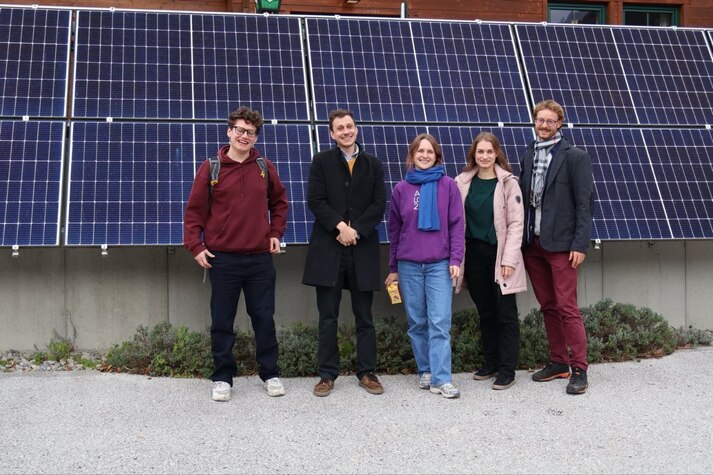
A group of friends on a study visit standing in front of a solar array
Proposal code:
CONSUL-2025-11-22
Student-led Energiegemeinschaft pilot: start with one building, cut bills, add rooftop PV, build neighbourhood skills and a strong community with funding by direct stakeholders and owners.
This idea was conceptualised during a workshop hosted by OurPower at the Vienna LCOY 2025.
Founders of renewable energy communities (RECs) in Austria tend to be middle-aged adults or seniors, often able to fund a significant part, if not all, of the necessary installations themselves. For students, this is hardly ever the case. Three friends, Lukas, Luis and Daniel, each in their early twenties set out to join a renewable energy community in spite of the economic limitations that come with being young - by making some noise and starting local:
We argue that even if the owners of the apartments/houses/or real estate managers have the necessary funds, they probably still lack the knowledge about the implications and advantages of the relatively new renewable energy community frameworks put forth by the EU, which are slowly being adapted country-by-country. Through local campaigning, bringing together people from the community and the neighborhood they want to raise awareness and fund three key goals:
- lower residents’ electricity costs
- accelerate rooftop PV deployment
- grow a skilled, mutual-aid network around energy.
We start small: one building in a local energy community (GEA = "Gemeinschaftliche Erzeugungsanlage") as a pilot project, knocking on the local neighborhood doors, finding out who is interested and what skills they could bring to the project. Beyond the practicalities there’s the social aspect, getting to know the people that already live next door, with the promise of becoming a tighter-knit community.
This also includes looking for specific offers from manufacturers, finding out what work would need to be done on the buildings and what specific regulations could apply - also what a realistic approach actually could like and building the knowledge of what the most important variables and factors are in our case.
With a draft and concrete offers we then approach the owners and managers of the buildings that we live in to look for support to make the project happen, laying out scenarios and cost options for different funding paths.
However, community-building stays the backbone throughout. The community meets regularly (e.g. monthly) with meetings discussing progress, hosting workshops and sharing skills whereever possible: The goal is to empower the people to carry the know-how outwards - democratizing knowledge and skills so that the next-block neighbors can pick up where we left off. PV monitoring, energy literacy, DIY maintenance basics, etc. just to name some examples.
Member tariffs would be negotiated fairly by the members themselves, with neighbours supporting each other. Any surplus from the community club goes into local events in the spirit of Austrian "Grätzlfeste", or into a social fund to support low-income households.
But why should building owners and landlords care?
Because it just makes sense! For local/regional "Energiegemeinschaften" = RECs in Austria, parts of the network usage charge are reduced by up to ~57% of the relevant grid-fee component for local RECs, improving tenants' bills and self-consumption economics. That also raises the real estate asset value - who doesnt like living where you pay less on your monthly bill? Furthermore, this might even help towards potential ESG or CSRD goals for real estate managers.
As further incentives, owners can take a share of tenant bill savings until the system is amortised, and a successful project brings positive publicity and essentially “free marketing” for the location. Perhaps even external support - EU or national grants - can play a role, to be researched and applied on a case-by-case basis.

Most voted